
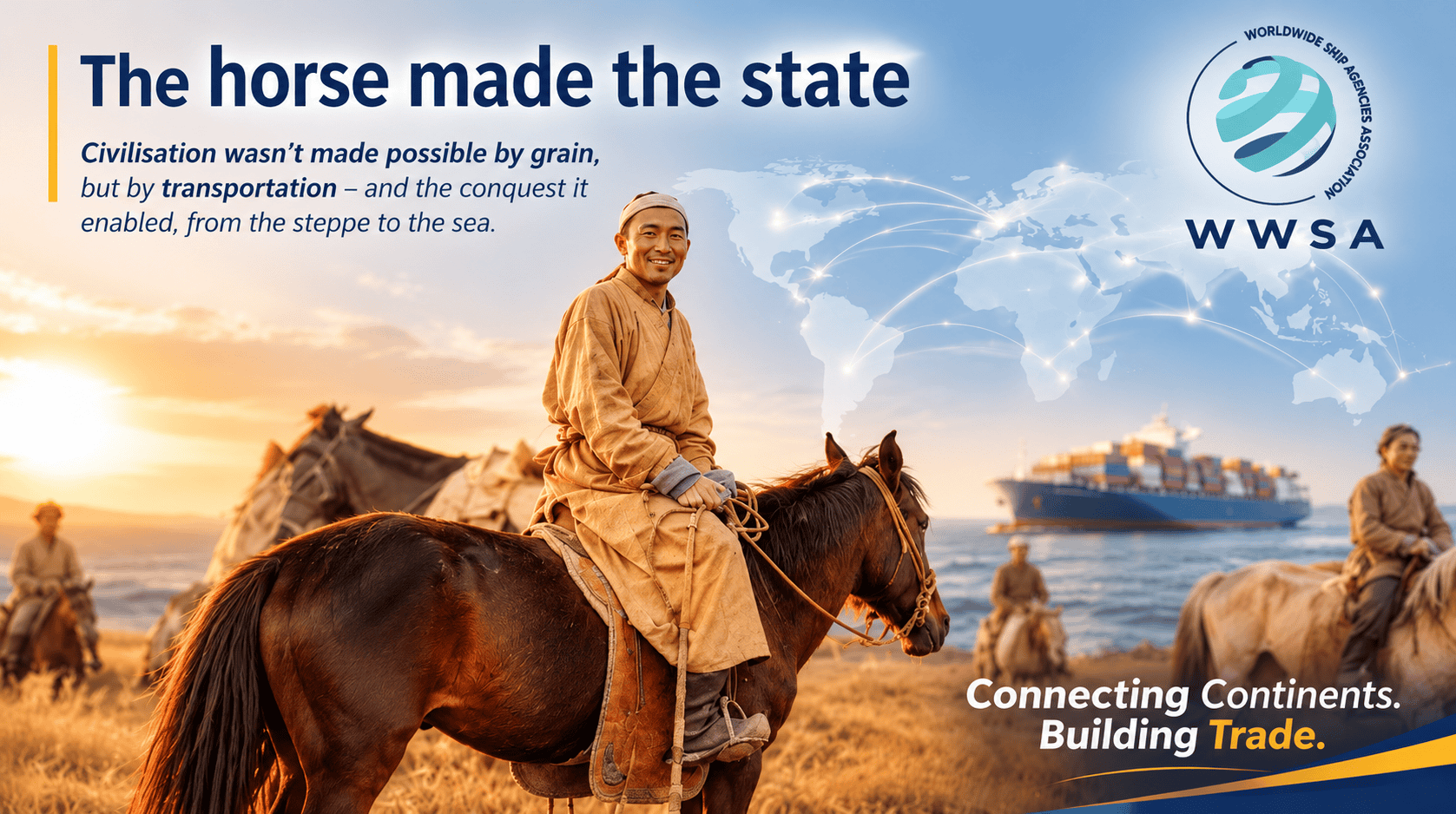
Transport built the state: The horse that made empires possible.
The Mongolian historian Lhamsuren Munkh-Erdene argues that the state did not originate in agriculture and grain—as the dominant thesis put forward by scholars such as James C. Scott, Robert Carneiro, and Jared Diamond holds—but in extra-human transportation (transport that goes beyond what a person can do using only their own body) and conquest.
Without pack and riding animals, human communities remain small, egalitarian, and dispersed, unable to concentrate populations and resources on a large scale. The domestication of horses, donkeys, and other herd animals, together with the invention of boats, made long-distance mobility possible and, with it, the formation of states and civilizations.
The great empires of the steppe, including the Mongols, show that it is possible to build a powerful state without intensive agriculture, relying instead on pastoralism and control of horses. The Romans reached as far as their ships could take them; the Mongols, as far as their horses could carry them. Power has always depended on control of transportation.
Munkh-Erdene argues that the idea that the state emerged from settled agriculture is largely a construct of the 20th century, rooted in Cold War politics and marked by a pronounced Sinocentric bias that deliberately erases the role of nomads.
Ultimately, the horse made the state possible. Civilization was built not on grain, but on the ability to move, conquer, and concentrate power on a large scale. The Eurasian steppe—not just the agricultural river valleys—holds a central place in human history.
Sources; L. Munkh-Erdene, Pablo Malo & WWSA Research